Robotics that take on risk.Clinicians who stay closer to patients.
Taipei Veterans General Hospital is moving from isolated robot deployments to integrated clinical automation—connecting AI, medical devices, autonomous mobile robots, and lifecycle governance.
OMNIVERSE DIGITAL TWINAutomated return of contaminated operating-room case cartsAccelerated simulation · 01:23
From technology demonstration to verifiable clinical service
STANDARDIZEINTEGRATEVALIDATEGOVERN
01 — NUCLEAR MEDICINE AUTOMATION
From system concept to integrated clinical workflow
Five project briefs document how TVGH advanced the automated radiopharmaceutical dispensing system from workflow definition in November 2025 to core automation and logistics integration by August 2026.
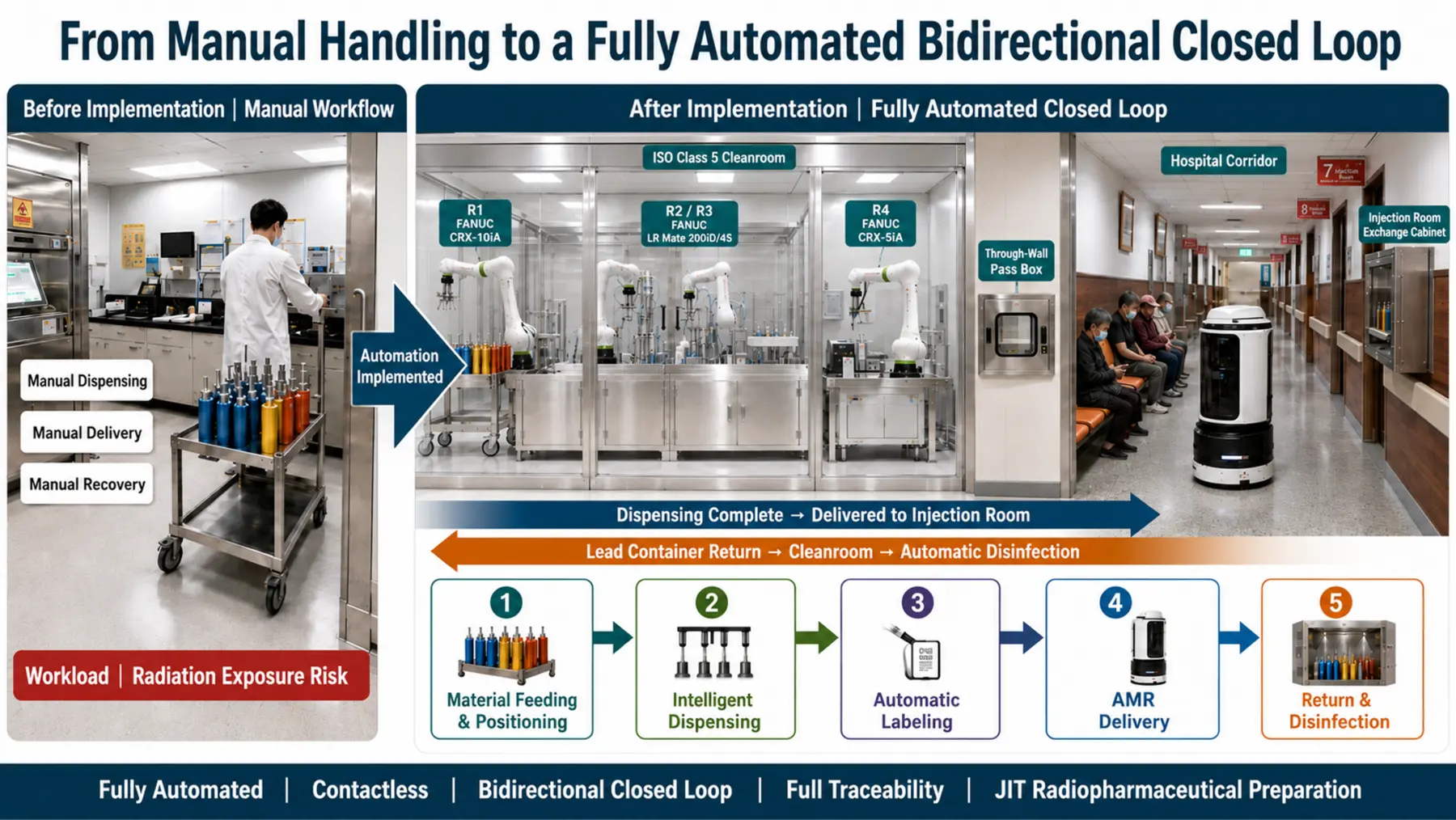
Blueprint: from manual handling to an automated bidirectional closed loop
NOV 2025WORKFLOW DEFINED
01
System blueprint and innovation showcase
Following the 2025 Taiwan Innotech Expo showcase, the team mapped the six manual operations—from preparation to delivery—and framed a four-part system combining cleanroom robots, precision dispensing, syringe transfer, and enclosed AMRs.
Mapped the baseline workflow across material preparation, quality control, dispensing, labeling, transport, and return.
Assigned four automation subsystems: R1 material handling, R2–R3 dispensing, R4 transfer and labeling, and enclosed AMR logistics.
Connected the cleanroom, pass box, corridor route, and injection-room exchange cabinet as one traceable service loop.
6 baseline processes4 integrated subsystems
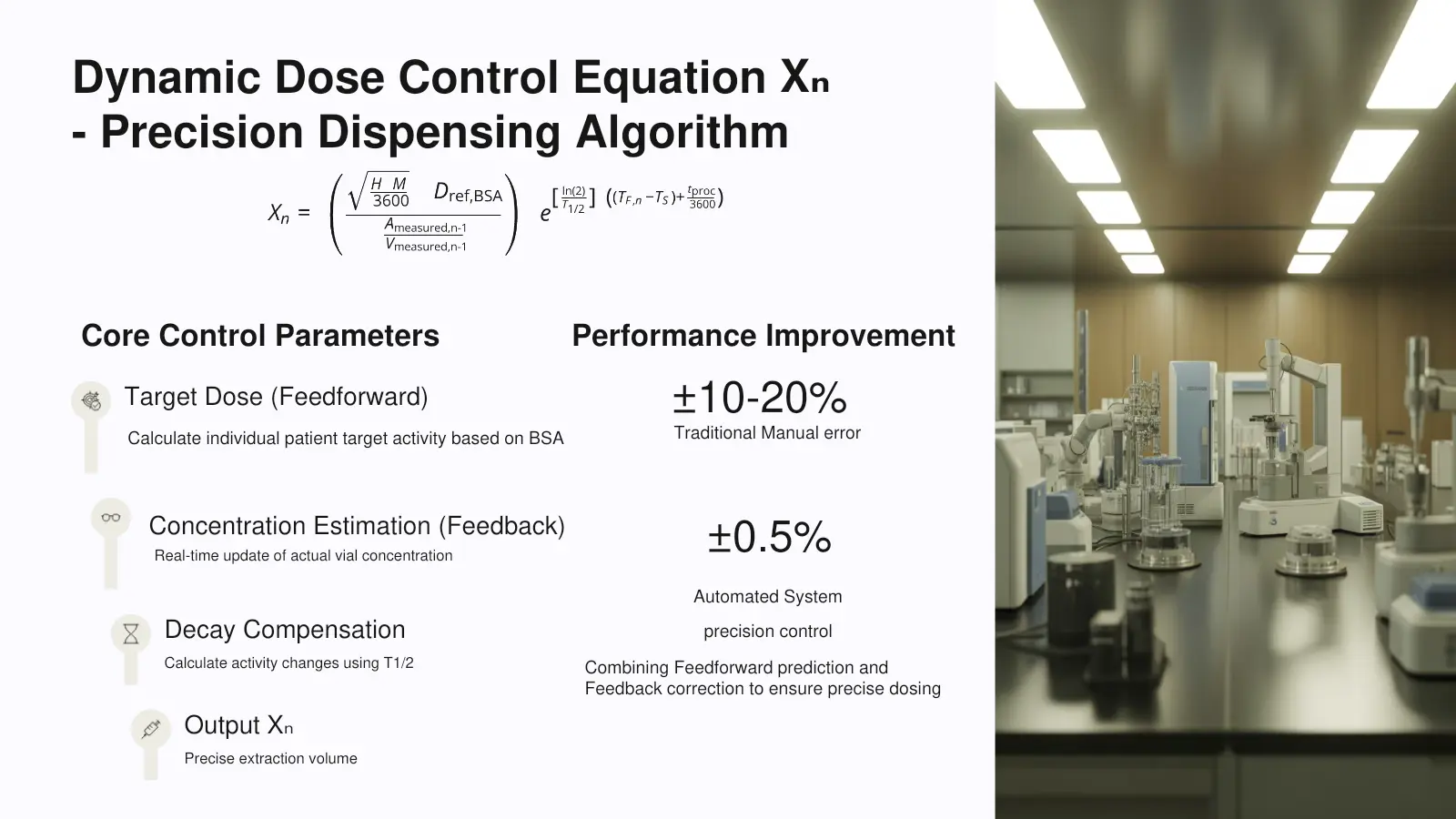
Control logic: patient-specific target activity translated into draw volume
DEC 2025ALGORITHM DEFINED
02
Precision-control architecture
Specified the Xₙ control architecture: patient-specific target activity, concentration feedback, and radioactive-decay compensation, with ±0.5% defined as the system accuracy target.
Uses patient data and body-surface-area rules to calculate the prescribed target activity.
Feeds measured vial concentration back into the control loop instead of relying on a fixed nominal value.
Compensates for radioactive decay between reference time and dispensing time before calculating the required withdrawal volume.
Xₙ precision algorithm±0.5% design target
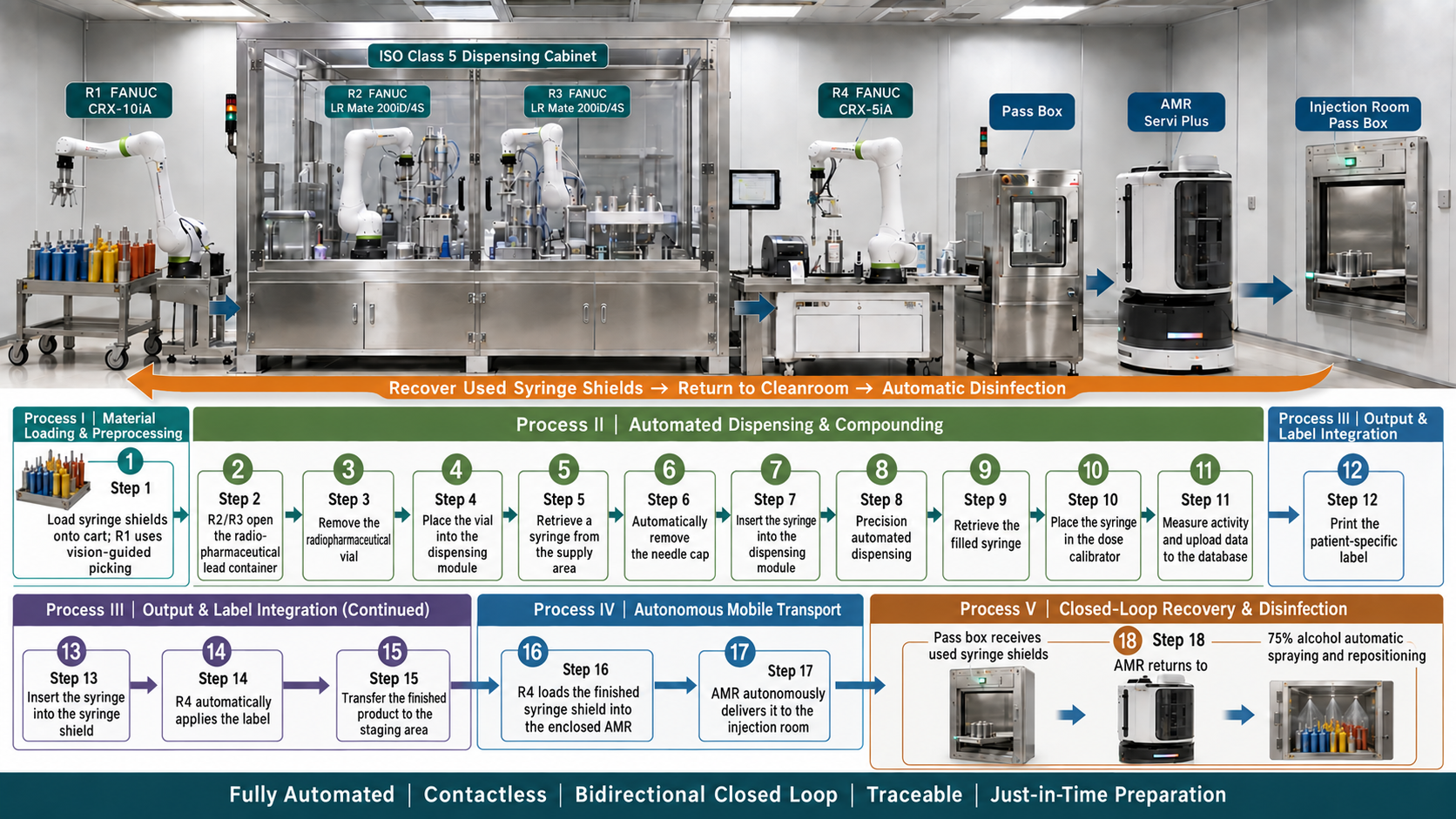
63-second system animation: robotic dispensing cell and material flowOpen the complete 18-step workflow
MAR 2026ENGINEERING PLAN
03
Smart cell and 210-day execution plan
Converted the concept into an 18-step cell layout, robot roles R1–R4, digital-twin verification, secure closed-loop logistics, and a staged installation and acceptance plan.
Structured 18 steps across input, quality control, dispensing, labeling, autonomous delivery, return, and disinfection.
Defined robot roles: CRX-10iA for R1, LR Mate 200iD/4S for R2–R3, and CRX-5iA for R4.
Used digital-twin and physical proof-of-concept verification before staged installation, interface testing, and acceptance.
18 automated stepsR1–R4 robot roles
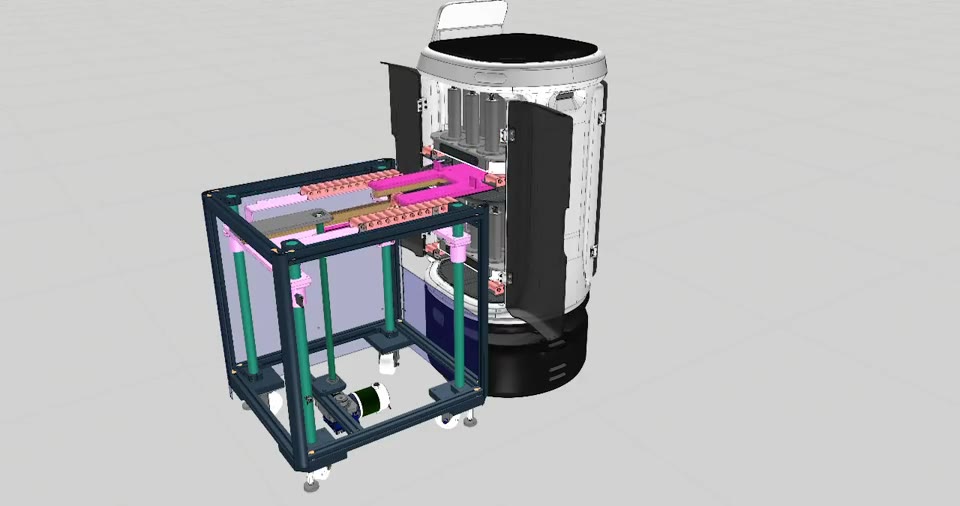
Milestone snapshot: the AMR-to-cabinet interface
MAY 2026LOGISTICS DESIGN
04
Closed-loop logistics interface defined
Finalized the physical interface and acceptance criteria needed to connect cleanroom dispensing with the injection room through one bidirectional AMR route.
Outcome: one sealed interface for outbound dose delivery and used-carrier return.
Acceptance focus: docking, payload, door interlocks, identity, and handover records.
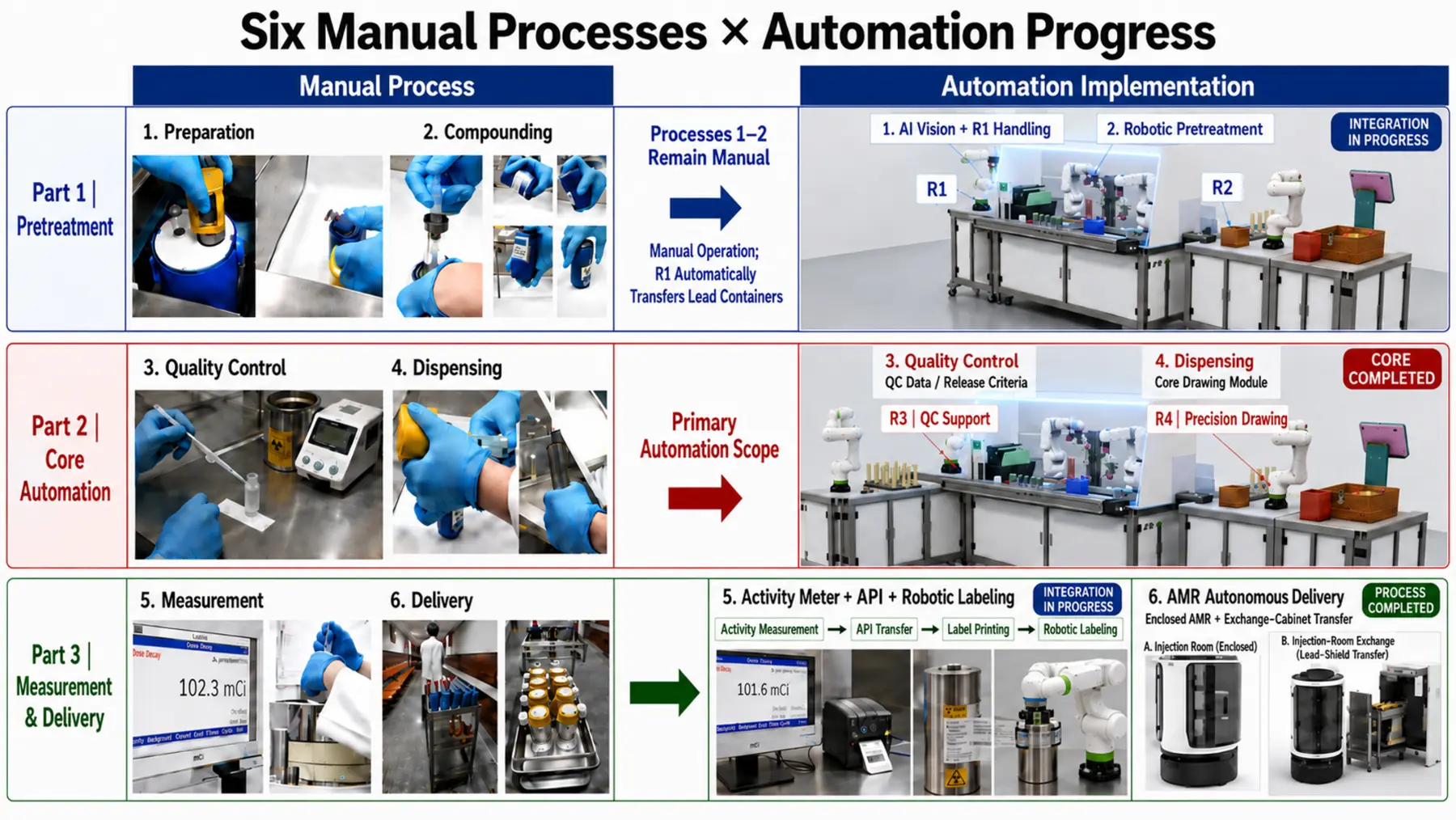
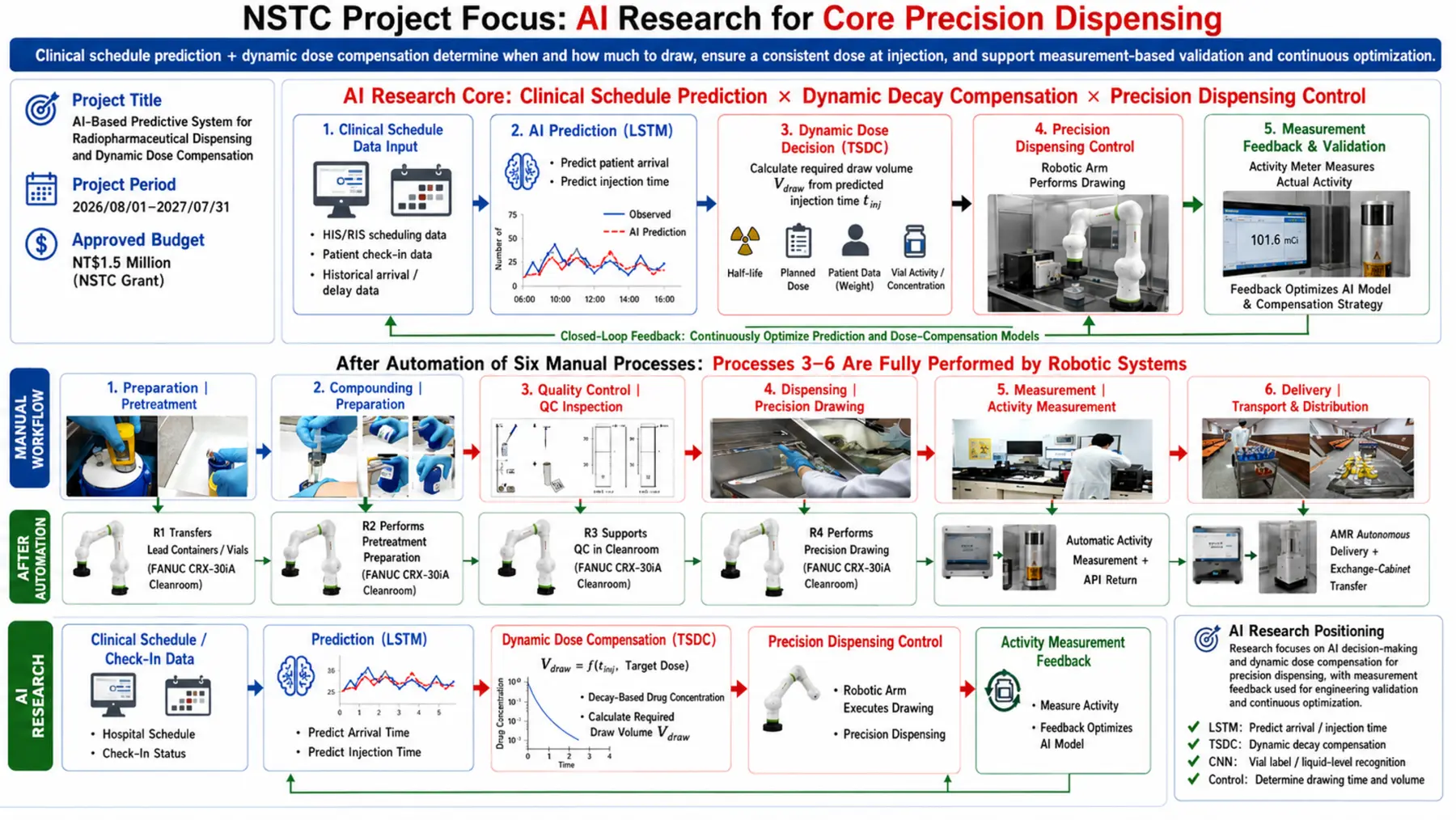
Integration status: completed core modules and interfaces still in progressNSTC research: AI-assisted precision dispensing, August 2026–July 2027
AUG 2026INTEGRATION
05
Core automation completed; integration advanced
Core quality-control and dispensing modules and the AMR delivery process were completed. Pretreatment vision and handling, activity-meter/API connectivity, and robotic labeling remained in integration; engineering review also covered load, power, and network interfaces.
Completed the quality-control and dispensing core and the autonomous AMR delivery process.
Continued pretreatment vision and handling plus activity-meter, API, and robotic-labeling integration.
Launched a NT$1.5 million NSTC study combining LSTM demand prediction, TSDC control, precision dispensing, and activity-measurement feedback.
Core modules completedNSTC research launched
Source: internal project progress briefs dated November 2025, December 2025, March 2026, May 2026, and August 2026. Stated performance values are design targets unless otherwise identified as completed work.
WORKFLOW DEEP DIVE
Five controlled handoffs, one closed loop
The roadmap above records the May 2026 design milestone. This section shows the operating sequence once, from AMR arrival through carrier return and disinfection.
37-SECOND DESIGN ANIMATIONDock · open · transfer · reset · depart
The enclosed AMR reaches the injection-room exchange cabinet and confirms its docking position.
02
Door opening after alignment
After docking is confirmed, the AMR compartment and exchange cabinet open for a closed, low-contact handover.
03
Automatic carrier transfer
The exchange mechanism moves the lead-container carrier horizontally into or out of the AMR, reducing manual lifting.
04
Position confirmation and reset
The system confirms the carrier position, closes the doors, and records arrival and handover status.
05
Bidirectional return and disinfection
Used lead containers follow the reverse route to the cleanroom for automated 75% alcohol disinfection and reset.
The animation illustrates the mechanical and workflow concept. Routine operation remains subject to final safety interlocks, docking verification, infection-control requirements, and acceptance documentation.
02 — PROGRAM PORTFOLIO
Six highlights from the full Chinese site
A concise view of high-risk task automation, intelligent hospital logistics, human–robot collaboration, and evidence-based governance.
01SMART LOGISTICS
Operating Room Case-Cart AMR Logistics
Ten AMRs connect surgical schedules, dispatching, elevators, and visual control to automate cross-floor case-cart return and delivery.
10 AMRs · 200 carts · ≥95% task success target
02CLINICAL AUTOMATION
Nuclear Medicine Dispensing & Delivery
Four cleanroom robot arms, activity feedback, labeling, and three enclosed AMRs form a traceable dispensing-to-delivery loop designed to minimize occupational exposure.
18 steps · ≤90 sec per dose · 3 enclosed AMRs
03PHARMACY AUTOMATION
Automated Chemotherapy Compounding
Robotic compounding integrates prescription verification, precise preparation, closed-system handling, and digital records to strengthen safety and consistency.
Closed-loop verification · standardized workflow
04HUMAN–ROBOT COLLABORATION
Technology-Enabled Intensive Care Unit
Mobile robots support transport, retrieval, and routine logistics so critical-care professionals can spend more time on direct patient care.
TICU deployment · task-oriented collaboration
05CLINICAL EVIDENCE
Nutrition Delivery Study
A prospective, IRB-approved comparison evaluated robot-assisted meal delivery across twelve wards while documenting waiting time, temperature, integrity, satisfaction, and human intervention.
120 deliveries · 12 wards · IRB-approved study
06LIFECYCLE GOVERNANCE
Enterprise Robotics Governance
A hospital-wide governance model aligns clinical needs, infrastructure, cybersecurity, acceptance testing, maintenance, incident reporting, and continuous improvement.
Shared standards · traceable records · scalable deployment
03 — SYSTEM ARCHITECTURE
Five layers, one connected service
Automation becomes reliable when clinical events, AI decisions, sensing, device control, and governance are designed as one system.
01
Clinical Data
HIS/RIS, schedules, destinations, and patient-flow events
02
AI Decision
Prioritization, prediction, and dynamic compensation
03
Edge Sensing
Barcodes, vision, location, activity meters, and LiDAR
04
Device Control
Robot arms, AMRs, elevators, and automatic doors
05
Data Governance
Cybersecurity, audit trails, versions, and KPIs
04 — CLINICAL GOVERNANCE
Four gates before routine operation
Every deployment is evaluated as a clinical service—not only as a robot—so safety, integration, evidence, and long-term ownership remain visible.
01
Need & Value
Define the clinical problem, baseline workload, risk, and intended benefit.
02
Site & Integration
Verify routes, elevators, access control, networks, charging, fire safety, and clean/dirty zoning.
03
Safety & Acceptance
Test obstacle avoidance, emergency stops, payloads, cybersecurity, infection control, and exception handling.